
Kootenai Scheduled Versus Actual Release
A projected, scheduled, or tentative date is a forecast tied to the record system that displays it. It may be useful for planning when to check, but it does not prove that the person walked out. Kootenai County's current-inmate PDF has a Scheduled Release Date field. Some live entries have shown dates already in the past, so the field is plainly not conclusive. Actual release is an event recorded after processing. Idaho VINE, direct jail confirmation, or a release record is the stronger source.
A pretrial detainee has no sentence-based date. Release may depend on bond, dismissal, a plea, sentencing, or another court order. A state prisoner can have several date fields with different meanings. Never copy one date without its label and source.
Find a Kootenai Release Date
Begin with the agency that has custody. The county jail and IDOC do not use the same calculation or public record. A removal from the KCSO roster can also mean transfer to IDOC, another county, the U.S. Marshals Service, or ICE rather than community release.
- Check the KCSO current-inmate report to see whether the person is still held and note its “current as of” timestamp.
- For a county sentence, compare the Scheduled Release Date with the signed judgment and credited jail time. Ask Kootenai County Jail for the actual release field when the date passes.
- For an Idaho prison sentence, search the IDOC Resident/Client Search by name or IDOC number and open the matching detail.
- Read each IDOC label exactly. PED, TPD, Sentence Satisfaction Date, and Released to Supervision are not substitutes for each other.
- Confirm the event through the jail, IDOC, Idaho VINE, or the court record. Use the Kootenai released-inmate path if custody type is unclear.
The official IDOC detail illustrates the separate Parole Eligibility Date and Sentence Satisfaction Date fields. Review it through the IDOC search source.
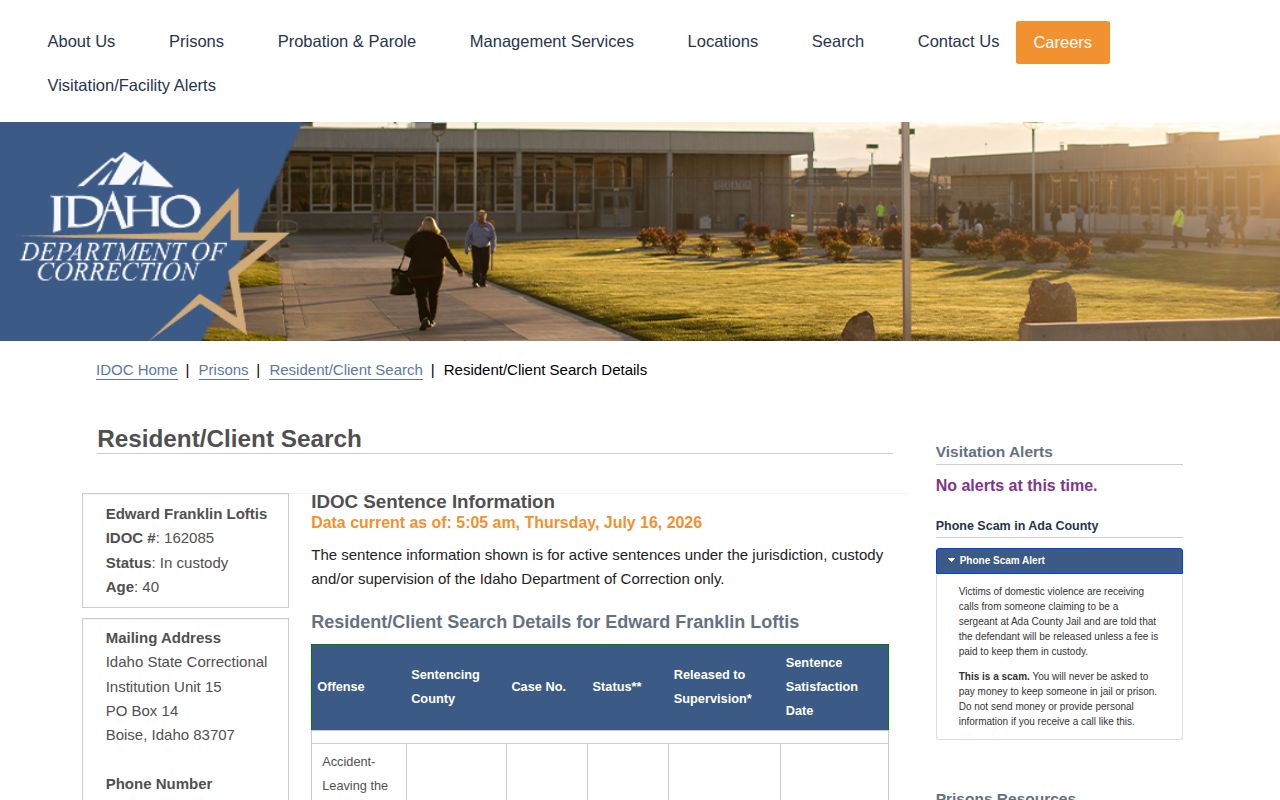
The two dates answer different questions. Eligibility opens a possible parole path; satisfaction marks the sentence's full-term endpoint.
Idaho Has No General 85% Rule
Idaho does not use a general rule that every person must serve 85 percent of a sentence. Importing that formula from another state produces a false Kootenai County projected release date. Under Idaho Code section 19-2513, the court imposes a unified sentence with a fixed minimum and may add an indeterminate term. The fixed part is generally served in full before ordinary parole eligibility.
During that fixed minimum, ordinary parole, discharge, and good-conduct reduction are unavailable. Narrow statutory routes, including meritorious service under section 20-101D and medical parole under section 20-1006, should not be turned into a broad good-time promise. IDOC Sentencing Records is the authoritative calculation unit. Jail credit can affect the start and calculation, but ordinary “good time” cannot simply be subtracted from the fixed term.
Idaho's Commission has discretion once a person reaches the indeterminate part. Eligibility does not create a right to parole. Mandatory minimums, life without parole, and offense-specific rules can delay or foreclose the ordinary path.
Kootenai Release Date Vocabulary
Idaho's terms are easy to collapse into one misleading date. Each belongs to a distinct stage of the sentence. The label must remain attached whenever a result is shared or requested.
| Field | What it means | What it does not prove |
|---|---|---|
| Scheduled Release Date | County jail report's expected date | Actual exit from Kootenai County Jail |
| PED | Parole Eligibility Date, when ordinary consideration can begin | That parole was granted |
| TPD | Tentative Parole Date after Commission action | That all release conditions were met |
| Released to Supervision | Move from prison custody to community parole supervision | End of the sentence |
| Sentence Satisfaction Date | Full-term endpoint computed by IDOC | An earlier parole release date |
| Retained Jurisdiction End Date | End point tied to Idaho's retained-jurisdiction process | Automatic community discharge |
| Discharged | IDOC sentence has been satisfied as of the shown date | That no separate case exists |
How Idaho Computes the PED
The Parole Eligibility Date begins with the judgment's fixed and indeterminate structure, effective date, credited time, and whether multiple terms run at the same time or one after another. Concurrent sentences overlap. Consecutive sentences run in sequence. The Commission's guidance says that with multiple sentences, the latest indeterminate begin date controls the PED. That is why adding the printed terms without the judgment and credit record can fail.
The usual flow is: court judgment → fixed minimum and credits → PED → Commission hearing and action → conditional TPD → plan and program completion → actual Released to Supervision → eventual Sentence Satisfaction or Discharged status. No arrow guarantees the next event. A hearing may occur about six to nine months before PED, but a hearing appearance alone is not a release decision.
- Fixed minimum
- The prison term generally served before ordinary parole eligibility.
- Indeterminate term
- The remaining sentence range in which parole may be considered.
- Detainer
- A request by another authority to hold or receive the person.
- Credit for time served
- Court-recognized custody time applied to the sentence calculation.
Why Kootenai Release Dates Change
A valid date can move or cease to describe the expected outcome. The reason should be found in a new agency event, court order, or calculation record, not inferred from a stale page.
| Factor | Possible effect | Where to verify |
|---|---|---|
| Corrected custody credit | Recalculated sentence milestone | Court judgment and IDOC Sentencing Records |
| Concurrent or consecutive terms | Different controlling PED | Judgments and IDOC calculation |
| Programming or plan approval | TPD delayed before departure | Commission action and IDOC |
| Misconduct or rescission | Conditional parole date changed or withdrawn | Notice of Action Taken |
| New warrant or detainer | Continued custody or transfer | Holding and receiving agencies |
| Court order | Bond, sentence, or release basis changes | Idaho iCourt and signed order |
A TPD can change because required programs, an approved release plan, paperwork, misconduct, forfeiture, a new warrant, or rescission remains unresolved. The Commission's grant is conditional. Confirm the later IDOC “In community / Parole” and “Released to Supervision” fields before describing prison release.
Confirm Kootenai Actual Release
Use Idaho VINE for an alert when the participating jail or corrections agency reports a release or transfer. An alert is evidence of the event reported by that agency, but its wording still matters. “Transfer” is not community release. “Out of Custody” applies to the named agency episode and may coexist with a new custodian.
The jail at 5500 N. Government Way can confirm immediate Kootenai custody at 208-446-1400. For a historical event, request the actual release date, release type, destination or receiving agency, and booking number through KCSO records. For a state sentence, use IDOC's status and Sentencing Records. The VINELink Check explains alert registration and the phone PIN.
When the evidence remains mixed, use careful language: “scheduled for,” “eligible on,” or “tentatively granted” rather than “released.” Reserve the last term for a recorded departure.
Kootenai Court and Credit Records
Sentencing records can change after a corrected judgment or credit order. A docket may show that an order exists, but the signed document gives the operative terms. Kootenai District Court Records supplies case-specific copies, and IDOC applies qualifying orders to its calculation. Allow for that agency handoff before treating a new filing as a changed public date.
Bond payment does not create a firm exit time. Authorization may precede review, release processing, and a check for other holds. The court sets the terms while the jail records physical departure. Use both records to decide whether a date was merely expected or completed. For a historical request, identify the person, booking episode, and date range. Ask for the actual release time, release type, and receiving agency if those fields are maintained and public.
Kootenai Custody Type Controls
A county jail date cannot answer a state prison question. Likewise, a BOP past release date ends federal prison custody but does not resolve later supervision or a new Idaho case. If the KCSO entry names USMS, FBI, ICE, another county, or a hold for another agency, disappearance may mean transfer. Use “transferred out of Kootenai custody” until a second source supports community release.
When no public match appears, repeat the search with verified spelling, aliases, birth year, and an identifying number. State the limited result with a date, such as “no matching public result located in IDOC,” rather than claiming the person has no sentence or is free.
Public Record Search
Sponsored Results